
Self Drilling screw strong hai… but rust sab khatam kar deta hai.
Here’s the fully expanded, SEO-friendly and educational version for your website:
Corrosion Resistant Self Drilling Screws – Why Corrosheild Xylan Coated Screws Are the Smart Choice for Long-Term Fastening
The Real Problem Nobody Talks About After Installation
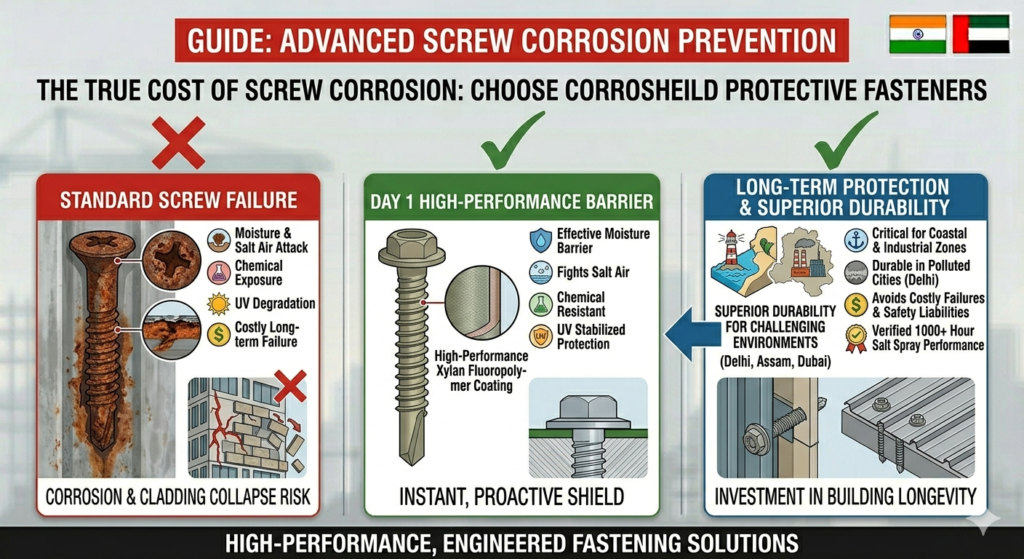
One of the most overlooked problems in construction, cladding, roofing, and structural fastening is screw corrosion. Everything looks perfect on day one. But within months — sometimes weeks — screws installed in exposed environments begin to rust. What starts as a surface discoloration quickly becomes a structural problem that is expensive, dangerous, and entirely preventable.
The root cause is simple: environmental exposure. Rain, moisture, humidity, salt air, industrial fumes, and temperature cycling all attack unprotected metal fasteners relentlessly. If your screws are not engineered to resist these forces, corrosion is not a possibility — it is a certainty.
What Corrosion Actually Does to Your Fasteners and Structure
Corrosion is not just a cosmetic issue. It is a progressive structural threat that compounds over time. Here is what happens when corrosion is left unaddressed:
Stage 1 – Surface Rust: The outer coating breaks down and oxidation begins on the screw surface. At this stage, the screw still holds but protection is gone.
Stage 2 – Strength Reduction: As rust penetrates deeper into the screw body, the cross-sectional area reduces. The screw’s rated load capacity drops significantly below its original specification.
Stage 3 – Structural Weakening: The connection point between the screw and the substrate becomes compromised. Panels, sheets, or structural members begin to loosen.
Stage 4 – Fastener Failure: The screw snaps, strips, or pulls out entirely. At this stage, the connected material — whether roofing sheet, cladding panel, or structural component — is at serious risk of detachment or collapse.
This progression can happen within 1 to 3 years in high-exposure environments when standard uncoated or poorly coated screws are used.
Where Corrosion Happens Most — High Risk Environments You Must Know
Not all environments are equal when it comes to corrosion risk. The following locations and conditions dramatically accelerate screw corrosion and demand superior corrosion protection:
✔ Outdoor Installations – Any external facade, roofing, or structural application exposed to open weather including rain, UV radiation, and temperature swings ✔ Coastal and Marine Areas – Salt-laden sea air is one of the most aggressive corrosion accelerators known. Screws in coastal buildings can corrode up to 5 times faster than inland installations ✔ Industrial Environments – Chemical fumes, airborne pollutants, acid rain, and high humidity in factories and industrial zones rapidly degrade unprotected fasteners ✔ Wet and High Humidity Areas – Bathrooms, kitchens, water treatment facilities, swimming pools, and any area with persistent moisture exposure ✔ Cold Storage and Refrigeration Facilities – Condensation cycles create constant moisture exposure on all fasteners ✔ Pollution-Heavy Urban Areas – Cities like Delhi, Mumbai, and similar metros with high pollution indexes where atmospheric corrosion is significantly elevated
If your project falls into any of these categories, standard screws are simply not sufficient.
The Solution – Corrosheild Xylan Coated Self Drilling Screws
The most effective and proven solution to screw corrosion in demanding environments is the use of Corrosheild Xylan Coated Self Drilling Screws — a premium fastening solution specifically engineered for high-exposure applications where long-term performance and corrosion resistance are non-negotiable.
What Is Xylan Coating and How Does It Work?
Xylan is a high-performance fluoropolymer-based coating system that creates a tough, chemically resistant barrier over the entire screw surface. Unlike standard zinc plating or basic galvanizing, Xylan coating bonds at a molecular level with the substrate and provides multi-layer protection against moisture, chemicals, UV radiation, and mechanical abrasion.
Key properties of Xylan coating include:
✔ Excellent resistance to salt spray, moisture, and humidity ✔ Chemical resistance to acids, alkalis, and industrial solvents ✔ Low friction coefficient for smooth, consistent installation ✔ Resistance to UV degradation and temperature extremes ✔ Superior adhesion that does not peel, chip, or flake under stress ✔ Compliance with international corrosion resistance standards
This makes Xylan coated self drilling screws the preferred choice for architects, structural engineers, and contractors working on projects in coastal, industrial, and high-humidity environments worldwide.
Key Benefits of Corrosheild Xylan Coated Self Drilling Screws
✔ Exceptional Long Service Life – Dramatically extended fastener lifespan compared to standard zinc or phosphate coated screws, even in the most aggressive environments ✔ Superior Moisture and Salt Protection – Engineered to withstand prolonged exposure to rain, condensation, coastal salt air, and chemical-laden atmospheres ✔ Significantly Reduced Maintenance Costs – Fewer replacement cycles, less remedial work, and reduced downtime on your building or structure over its lifetime ✔ Consistent Clamping Force – The low-friction Xylan surface ensures accurate and consistent torque application during installation, preventing over-tightening and fastener damage ✔ Structural Integrity Preservation – Maintains rated load capacity throughout the service life of the fastener, keeping your connections strong and compliant ✔ Aesthetic Appearance – Clean, uniform coating finish that maintains a professional appearance on exposed fastener applications ✔ Versatile Application – Suitable for steel to steel, steel to timber, and sheet metal applications across roofing, cladding, facades, industrial structures, and more
Educational Insight – The True Cost of Cheap Screws
Many contractors and project managers choose standard uncoated or basic galvanized screws to reduce upfront material costs. This is one of the most common and costly mistakes in construction fastening.
Consider this real-world cost comparison:
A standard zinc coated screw may cost significantly less per unit than a Xylan coated alternative. But when that screw corrodes and fails within 2 to 3 years, the cost of replacement includes not just the new screws, but labour for removal and reinstallation, potential damage to the panels or sheets being refastened, scaffolding or access equipment costs, project downtime, and in worst cases, liability for structural failure or injury.
The total cost of a cheap screw failure is almost always 5 to 10 times higher than the original saving. Corrosion resistant fasteners are not a premium luxury — they are a cost-saving investment when viewed across the full lifecycle of your project.
Industries and Applications Where Corrosheild Xylan Screws Are Recommended
✔ Stone and metal cladding systems ✔ Roofing and roof sheeting installations ✔ Curtain wall and facade systems ✔ Pre-engineered building structures ✔ Industrial sheds and warehouses ✔ Cold storage and food processing facilities ✔ Coastal and marine construction projects ✔ Infrastructure and bridge construction ✔ Solar panel mounting systems ✔ HVAC and mechanical duct installations
Final Advice for Contractors, Builders, and Project Managers
Corrosion never announces itself. It starts silently, invisibly, and grows steadily until the damage becomes impossible to ignore. By the time rust is visible on a screw head, the structural degradation has already been underway for months.
The smartest decision you can make is to specify the right corrosion resistant fastener before installation — not after a failure occurs. Corrosheild Xylan Coated Self Drilling Screws give you the protection, performance, and peace of mind that standard fasteners simply cannot deliver in demanding environments.
Do not compromise on fasteners. They are the smallest component on your project and the most critical point of failure if chosen incorrectly.
📞 Call us before finalizing your screw selection — get expert technical advice for your specific application and environment 📲 WhatsApp us the word “ANCHOR” to receive product recommendations, technical datasheets, and customized fastening solutions for your project