

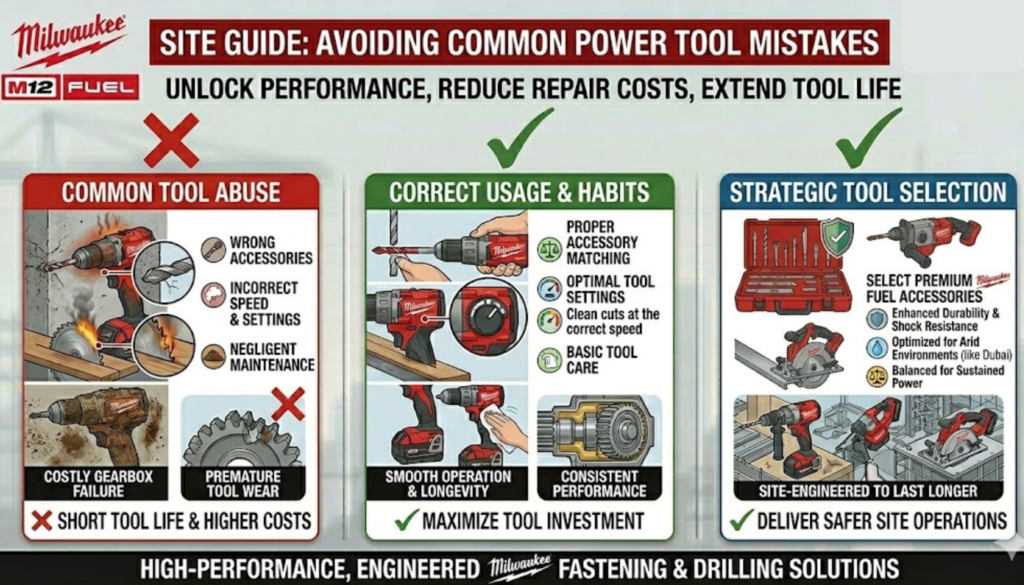
Tool Use Karna Bhi Ek Skill Hai – Using a Power Tool Is a Skill, Not Just a Task
Every experienced contractor, site engineer, and construction professional knows this truth: owning a good power tool is only half the battle. How you use it determines everything — the quality of your work, the safety of your team, the lifespan of your equipment, and ultimately the success of your project. Yet on construction sites across Delhi, Mumbai, Dubai, and beyond, the same power tool mistakes are repeated every single day — costing businesses time, money, and productivity.
This guide covers the most common power tool mistakes made on site, why they happen, and exactly how to avoid them so you get maximum performance, maximum safety, and maximum return on your tool investment.
The Real Problem – Wrong Usage Silently Destroys Performance
Most power tool failures and underperformance issues are not caused by poor quality tools. They are caused by incorrect usage. A professional-grade drill, grinder, or impact driver used incorrectly will underperform, wear out prematurely, and in some cases become a serious safety hazard on site.
Wrong usage reduces cutting efficiency, increases heat generation, causes premature bit and accessory wear, overloads the motor, and leads to inaccurate, poor quality work that needs to be redone — adding cost and delay to every project.
The good news is that every one of these problems is entirely preventable with the right knowledge and habits.
Most Common Power Tool Mistakes Made on Construction Sites
Mistake 1 – Using the Wrong Speed Setting
❌ The Problem: One of the most frequent mistakes on site is running a power tool at the wrong speed for the material or application. Drilling into concrete at high speed without hammer mode, cutting thin sheet metal at slow speed, or driving screws at maximum RPM without torque control — all of these destroy bits, damage materials, and overload tool motors.
✔ The Solution: Always match your tool speed to the material and task. Most professional drills and drivers have variable speed triggers and selectable gear settings for a reason. Use low speed and high torque for driving fasteners, medium speed for drilling in wood or metal, and correct hammer drill settings with appropriate speed for masonry and concrete. Always refer to the tool manufacturer’s recommended speed range for each application.
Educational Insight: Running a drill bit at too high a speed in hard materials generates excessive heat that destroys the cutting edge within minutes. This is why many site workers go through dozens of bits unnecessarily — the problem is speed, not bit quality.
Mistake 2 – Using the Wrong Bit or Accessory
❌ The Problem: Using a wood drill bit on concrete, a standard screwdriver bit with an impact driver, a cutting disc rated for wood on metal, or an undersized socket on a high-torque impact wrench — these are daily occurrences on construction sites and each one causes damage, poor results, and safety risk.
✔ The Solution: Always use the correct bit, blade, disc, or accessory specifically designed and rated for your tool and your material. Match the bit shank type to your tool’s chuck system. Use SDS bits for SDS hammer drills, impact-rated bits for impact drivers, and always verify that cutting and grinding discs are rated for the RPM of your specific tool before use.
Educational Insight: A grinding disc rated for 10,000 RPM used on a tool spinning at 12,000 RPM can shatter explosively — creating a life-threatening hazard for anyone nearby. Always check the RPM rating printed on every disc and wheel before mounting it on your tool.
Mistake 3 – Skipping Regular Tool Maintenance
❌ The Problem: Power tools on construction sites are exposed to dust, debris, moisture, vibration, and heavy use every single day. Yet maintenance is almost always the last priority — until the tool fails completely in the middle of a critical task. Blocked air vents, worn carbon brushes, dirty chuck mechanisms, dull blades, and degraded battery contacts all silently reduce tool performance over time.
✔ The Solution: Implement a simple but consistent tool maintenance routine on every site. After each use, clean dust and debris from vents, chucks, and housings. Inspect cords, plugs, and battery terminals regularly. Lubricate moving parts as recommended by the manufacturer. Replace worn carbon brushes before they cause motor damage. Store tools in cases or on racks — never leave them on the ground or exposed to weather.
Educational Insight: Most power tool motor failures are caused by dust ingestion through blocked or dirty air vents. A 2-minute cleaning routine after each use can extend tool motor life by years and prevent the most common cause of on-site tool breakdown.
Mistake 4 – Using Damaged or Worn Accessories Without Replacement
❌ The Problem: Continuing to use a dull drill bit, a cracked cutting disc, a stripped screwdriver tip, or a worn grinding wheel is one of the most dangerous and counterproductive habits on any construction site. Worn accessories require more force, generate more heat, produce poor quality results, and in the case of damaged discs or wheels, can fail catastrophically during use.
✔ The Solution: Inspect all bits, blades, discs, and accessories before every use. Replace any accessory that shows signs of wear, cracking, chipping, or damage immediately. Never attempt to sharpen or repair a cracked cutting disc. The cost of a replacement bit or disc is always less than the cost of damaged work, tool repair, or a site injury.
Mistake 5 – Ignoring Torque Settings on Drills and Drivers
❌ The Problem: Driving screws without setting the correct torque clutch results in overdriven fasteners that strip the substrate, snap screw heads, damage surface finishes, and compromise the holding strength of every connection. This is particularly critical in drywall, timber framing, and facade cladding applications.
✔ The Solution: Always set the torque clutch on your drill or driver to the appropriate level for the fastener size and substrate material before you start driving. Begin with a lower torque setting and increase gradually until you find the correct setting that seats the fastener flush without overdriving. Most professional cordless drills offer 16 to 25 torque settings — use them.
Mistake 6 – Not Using the Right Tool for the Job
❌ The Problem: Using a regular drill as a hammer drill for masonry work, using an angle grinder for precision cutting tasks, or using a jigsaw for straight cuts that require a circular saw — forcing the wrong tool into an application causes overloading, poor results, premature wear, and safety risk.
✔ The Solution: Invest in the correct tool category for each task. A hammer drill for concrete and masonry, an impact driver for fastener driving, an angle grinder for grinding and cutting, a circular saw for straight cuts in sheet material. The right tool makes every task faster, safer, and more accurate.
Mistake 7 – Poor Handling and Incorrect Grip
❌ The Problem: Operating a power tool with one hand when two are required, holding the tool at the wrong angle, applying excessive downward pressure on a drill, or standing in an unstable position while using a high-torque tool — all of these lead to inaccurate work, tool damage, and operator injury.
✔ The Solution: Always use both hands on tools designed for two-hand operation. Maintain a stable, balanced stance before starting. Apply steady, consistent pressure — let the tool do the work. Never force a tool beyond its natural cutting or driving speed as this overloads the motor and distorts the output quality.
Mistake 8 – Ignoring PPE and On-Site Safety Protocols
❌ The Problem: Operating angle grinders without eye protection, using rotary hammers without dust masks in enclosed spaces, or running power tools near water without proper insulation checks — safety shortcuts on site with power tools are responsible for thousands of preventable injuries every year.
✔ The Solution: Always wear appropriate personal protective equipment including safety glasses or goggles, hearing protection for prolonged tool use, dust masks or respirators when drilling or cutting in enclosed areas, and cut-resistant gloves when handling blades and discs. Follow all manufacturer safety guidelines printed in the tool manual — they exist because real injuries happened without them.
Tool Maintenance Checklist for Every Construction Site
✔ Clean dust and debris from air vents after every use ✔ Inspect power cords and plugs for damage before every use ✔ Check battery terminals and contacts on cordless tools weekly ✔ Replace worn or damaged bits, blades, and accessories immediately ✔ Lubricate chuck mechanisms and moving parts as per manufacturer schedule ✔ Store tools in protective cases away from moisture, dust, and direct sunlight ✔ Test torque and speed settings before beginning each new task ✔ Inspect all cutting and grinding discs for cracks before mounting ✔ Log tool service intervals and schedule professional servicing regularly
Why Correct Power Tool Usage Directly Impacts Your Project Quality and Profitability
Every mistake made with a power tool on site has a direct financial cost. Stripped fasteners need to be removed and re-driven. Damaged substrate materials need to be repaired or replaced. Broken bits and discs need to be replaced more frequently. Overloaded tools need servicing or replacement sooner than their rated service life. Poor quality work needs to be redone — consuming labour hours and materials that were never budgeted.
Correct tool usage, correct accessory selection, and consistent maintenance do not just improve work quality — they directly reduce your project costs and increase your team’s productivity on every single job.
Final Advice for Site Managers, Contractors, and Construction Professionals
A power tool is only as good as the person using it and the accessories paired with it. The difference between a professional result and a poor one is rarely about the brand of tool — it is almost always about knowledge, technique, correct settings, and the right accessories for the job.
Train your site team on correct tool usage. Implement a basic maintenance routine. Always specify the right accessories for every application. And never compromise on quality when it comes to the bits, blades, discs, and fasteners that go into your tools every day.
Correct usage equals better results, longer tool life, fewer accidents, and lower overall project costs.
📞 Call us before finalizing your power tools or accessories — get expert technical recommendations for your specific site applications and requirements 📲 WhatsApp us the word “ANCHOR” to receive product guidance, tool accessory recommendations, and professional fastening solutions tailored to your project