

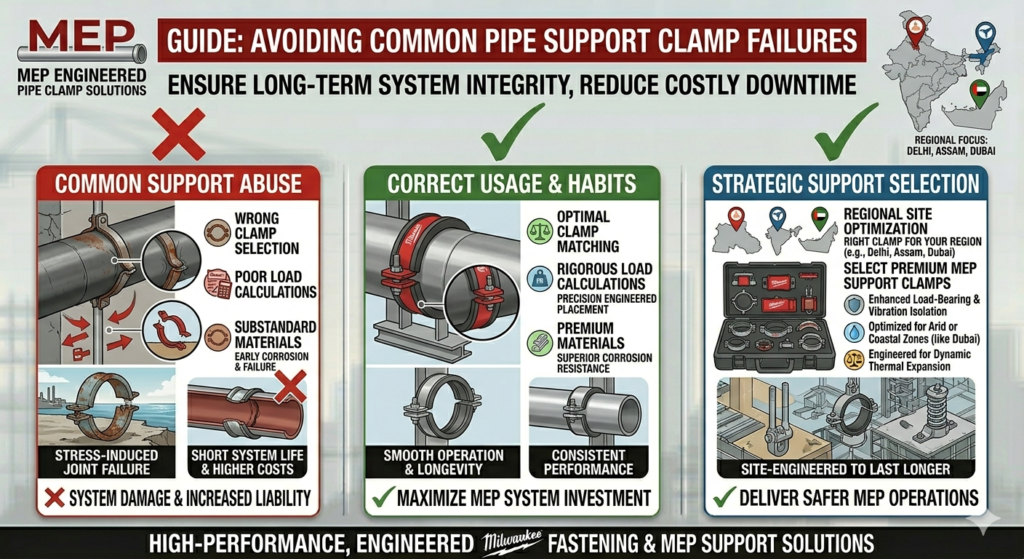
Pipe Support Fail Hota Hai… Aur Pura System Disturb Ho Jata Hai
In every MEP (Mechanical, Electrical, and Plumbing) project, there is one component that is consistently underestimated, under-specified, and under-budgeted — the pipe support clamp. It is small. It is inexpensive compared to the pipes, valves, and equipment it supports. And that is exactly why it is so often chosen carelessly. But when a pipe support fails, it does not fail quietly. It disturbs the entire system — triggering vibration, misalignment, leakage, noise complaints, and in serious cases, complete pipeline failure that shuts down operations and triggers expensive emergency repairs.
If you are a MEP contractor, HVAC engineer, plumbing consultant, or project manager working on buildings in Delhi, Assam, Dubai, or anywhere across India and the Middle East, this guide is essential reading before you finalize your next pipe clamp order.
The Real Site Problem – “Clamp Hi Toh Hai, Kuch Bhi Use Kar Lo”
This attitude is the single most dangerous mindset on any MEP project site. Pipe clamps are treated as a generic commodity — something to be sourced from the cheapest available supplier with no consideration for size, load rating, material quality, or environmental suitability.
The thinking goes: it is just a clamp. Any clamp will do.
But the reality on site tells a very different story. Within months of project completion, problems begin to surface. Pipes start vibrating during operation. Unusual noise travels through the building structure. Joints begin showing signs of stress and misalignment. Pipe sagging becomes visible. And eventually, leakage and damage follow — leading to maintenance calls, tenant complaints, insurance claims, and costly remedial work that was entirely avoidable from the beginning.
The root cause in almost every case traces back to one decision made at the procurement stage: the wrong pipe support clamp was selected, from the wrong supplier, without the right technical guidance.
Why Pipe Support Clamps Are Absolutely Critical in MEP Systems
A pipe support clamp is not just a bracket holding a pipe to a wall or ceiling. It is a precision-engineered component that performs multiple critical structural and mechanical functions simultaneously throughout the entire operational life of the building system.
Every pipe clamp in your MEP system is responsible for:
✔ Holding Full Pipe Weight — Including the weight of the pipe itself, the fluid or gas it carries, insulation cladding, and any additional attachments along the pipeline run ✔ Maintaining Precise Alignment — Keeping pipes running true and level to prevent stress accumulation at joints, bends, and equipment connections ✔ Reducing and Isolating Vibration — Preventing operational vibration from pumps, compressors, and flow turbulence from transmitting into the building structure and causing noise or fatigue cracking ✔ Supporting Long Pipeline Runs — Providing correctly spaced intermediate support across extended horizontal and vertical pipeline systems to prevent sagging and joint stress ✔ Accommodating Thermal Movement — Allowing controlled expansion and contraction of pipelines due to temperature changes without creating stress concentrations at fixed points ✔ Protecting Pipe Surface Integrity — Preventing direct metal-to-metal contact between pipe and support structure that causes galvanic corrosion and surface damage over time
If even one support in a pipeline system fails, the loads redistribute to adjacent supports and connections. This chain reaction of increasing stress leads to accelerated failure across the entire system.
If support fails — system fails. It is that simple.
Most Common Pipe Support Mistakes on MEP Project Sites
These mistakes are observed on construction and MEP installation sites every day across Delhi NCR, Assam, Dubai, and throughout India and the UAE:
❌ Using Low Quality or Uncertified Clamps — Generic, unrated clamps sourced purely on price with no load certification, no material specification, and no corrosion protection ❌ Wrong Clamp Size for Pipe Diameter — Using an oversized or undersized clamp creates uneven clamping pressure, pipe deformation, and connection instability ❌ Improper Support Spacing — Placing supports too far apart causes pipe sagging, joint stress, and flow inefficiency in gravity drainage systems ❌ Weak or Incorrect Anchor Selection — Fixing pipe clamps with undersized or wrong-type anchors into concrete, brick, or steel structure that cannot carry the combined static and dynamic loads ❌ No Vibration Isolation — Installing rigid metal clamps on pipelines carrying pumped fluids or compressed gases without rubber lining or isolation inserts, causing structure-borne noise and vibration fatigue ❌ Ignoring Thermal Expansion Requirements — Fixing all supports as rigid connections with no provision for pipeline thermal movement, creating dangerous stress buildup during temperature cycling ❌ Wrong Material Selection for Environment — Using uncoated mild steel clamps in humid, coastal, or chemically aggressive environments where corrosion rapidly destroys structural integrity ❌ No Engineering Review of Support Layout — Installing clamps based on visual judgment rather than engineered spacing calculations for the specific pipe diameter, material, fluid weight, and span
What Happens When Pipe Supports Are Wrong – The Real Consequences
The consequences of incorrect pipe support selection and installation are progressive and expensive:
Pipe Sagging — Unsupported spans deflect under load, creating low points where fluid accumulates, flow efficiency drops, and pipe stress concentrates at support points
Joint Leakage — Misaligned or sagging pipes place bending stress on threaded joints, flanged connections, and welded joints — eventually causing leaks that damage building fabric, electrical systems, and finished surfaces below
Noise and Vibration Complaints — Structure-borne vibration from unsupported or poorly isolated pipelines transmits through slabs and walls, generating noise complaints from building occupants that are extremely difficult and expensive to resolve after construction is complete
Increased Maintenance Costs — Corroded, failed, or displaced supports require regular inspection, replacement, and system realignment — adding recurring operational costs throughout the building lifecycle
Premature Pipe System Failure — In severe cases, accumulated stress from inadequate support leads to pipe fatigue cracking, joint failure, and complete system shutdown requiring full replacement
Project Reputation Damage — MEP system failures in completed buildings directly damage the reputation of the contractor, consultant, and developer responsible for the project
Correct Pipe Clamp Selection Guide – What to Check Before Every Purchase
Follow this technical checklist before specifying or purchasing any pipe support clamp for your MEP project:
1. Pipe Diameter and Schedule The clamp bore size must precisely match the outside diameter of the pipe including any insulation or cladding layer. Verify pipe OD against clamp bore dimension — never assume nominal pipe size equals actual outside diameter across all pipe materials and standards.
2. Load Calculation Calculate the total supported load including pipe self-weight, fluid or gas weight at full capacity, insulation weight, and any additional fittings or valves in the supported span. Select clamps with a rated load capacity that provides adequate safety factor above calculated load.
3. Support Spacing Use standard pipe support spacing tables based on pipe material, diameter, and fluid being carried. Steel pipes, copper pipes, CPVC pipes, and PPR pipes all have different maximum recommended span distances. Always follow engineering guidelines — never estimate spacing visually.
4. Environment and Corrosion Category Classify your project environment: indoor dry, indoor humid, outdoor urban, outdoor coastal, or chemically aggressive industrial. Select clamp material and coating accordingly — from standard galvanized for dry indoor use to grade 316 stainless steel for coastal and chemical environments.
5. Vibration Isolation Requirement For pipelines connected to pumps, compressors, chillers, or any rotating equipment — always specify rubber-lined clamps or acoustic isolation inserts to prevent vibration transmission into the building structure.
6. Thermal Movement Provision For hot water, steam, chilled water, and refrigerant pipelines with significant temperature variation — specify a combination of fixed anchor supports and sliding or guided supports that allow controlled thermal movement without pipe stress.
7. Anchor System Compatibility Always select the anchor bolt, chemical anchor, or mechanical anchor that is correctly rated for the substrate (concrete grade, brick type, or steel section) and the combined static and dynamic load of the pipe support being fixed.
Delhi and Dubai Site Conditions – Why Location Matters for Pipe Clamp Selection
Environmental conditions vary dramatically between project locations and must directly influence your pipe clamp material and coating specification:
Delhi and NCR Region: Seasonal temperature variation between extreme summer heat and winter cold creates significant thermal cycling stress on pipeline systems and support connections. High atmospheric pollution levels accelerate surface corrosion on unprotected steel clamps. Monsoon humidity combined with urban pollution creates a mildly corrosive atmospheric environment that degrades standard galvanized coatings faster than expected. Specify hot-dip galvanized or epoxy-coated clamps as a minimum for all outdoor and semi-exposed applications in Delhi.
Dubai and UAE Region: Salt-laden coastal air creates one of the most aggressive corrosion environments for metal components anywhere in the world. High ambient temperatures combined with extreme humidity levels in summer months create constant thermal and moisture stress on all building systems. Standard galvanized clamps are wholly inadequate for most Dubai MEP applications. Grade 316 stainless steel clamps with full corrosion certification are the recommended minimum specification for outdoor, rooftop, and plant room applications across the UAE.
Assam and Northeast India: Extremely high annual rainfall, persistent humidity, and flooding risk in low-lying areas create severe corrosion conditions for all metallic building components. Monsoon season brings prolonged moisture exposure to all building systems. Specify fully corrosion-resistant clamp materials for all Assam MEP projects regardless of indoor or outdoor location.
Why Your Pipe Support Clamp Supplier Choice Is as Important as the Product Itself
In the pressure of project timelines, most procurement decisions prioritize speed of supply and unit price above everything else. This approach consistently leads to the wrong product being delivered to site, installed incorrectly, and failing prematurely.
A reliable and technically competent pipe support clamp supplier in Delhi, Assam, or Dubai provides far more than fast delivery and competitive pricing. The right supplier offers complete technical product knowledge across the full range of pipe clamp types and configurations, application-specific guidance on clamp selection for your pipe size, load, and environment, corrosion category advice based on your project location and exposure conditions, anchor system recommendations to correctly fix your pipe supports into the substrate, load rating data and product certification documentation for engineering sign-off, and after-sales technical support when site conditions change during installation.
Choosing a supplier purely on price without technical capability is a false economy that almost always costs significantly more in remedial work, product replacement, and project delays.
Types of Pipe Support Clamps Available for MEP Projects
✔ Single Pipe Clamps — Standard fixed support for individual pipe runs in all sizes ✔ Double Bolt Pipe Clamps — Heavy duty support for large diameter and heavy pipes ✔ Rubber Lined Pipe Clamps — Vibration isolation and acoustic damping for pump and equipment-connected pipelines ✔ Insulated Pipe Clamps — Thermal break support for chilled water and refrigeration pipelines preventing condensation and heat gain ✔ Riser Clamps — Vertical pipeline support carrying full pipe weight at structural floor penetrations ✔ U-Bolt Pipe Supports — Versatile support for medium load horizontal pipeline applications ✔ Pipe Roller Supports — Sliding support allowing free thermal movement in high-temperature pipeline systems ✔ Clevis Hangers — Suspended ceiling support for horizontal pipeline runs from structural soffit ✔ Spring Hangers — Vibration isolating suspended support for dynamic pipeline systems
Final Advice for MEP Contractors, HVAC Engineers, and Plumbing Consultants
A pipe clamp is not a minor accessory. It is a structural and mechanical component that is fundamental to the long-term stability, performance, and safety of every pipeline system in your building. The decision made at procurement — about which clamp, which material, which size, and which supplier — determines whether your MEP system performs reliably for decades or begins showing problems within the first year of operation.
Do not treat pipe support clamps as a commodity purchase. Treat them as the engineered system components they are. Get the right technical advice before you order. Specify correctly for your pipe diameter, load, environment, and vibration requirements. And choose a supplier who understands the full application — not just the price per piece.
Your system stability depends on it.
📞 Call us before finalizing your pipe clamps — get free expert technical guidance for your specific MEP application, pipe size, and project location 📲 WhatsApp us the word “CLAMP” to receive pipe support clamp recommendations, load rating data, and complete fastening solutions for your project 🎯 Get free fastener and pipe support selection support from our technical team — serving MEP contractors and consultants across India and the Middle East
Supplying certified pipe support clamps, anchors, fasteners, and MEP hardware across Delhi, Noida, Gurgaon, Faridabad, Ghaziabad, Mumbai, Bangalore, Chennai, Hyderabad, Pune, Assam, Guwahati, Gujarat, Rajasthan, Dubai, Abu Dhabi, Sharjah, UAE, and all major cities across India and the Middle East.