

Heavy pipe hai… normal clamp se kaam nahi chalega.
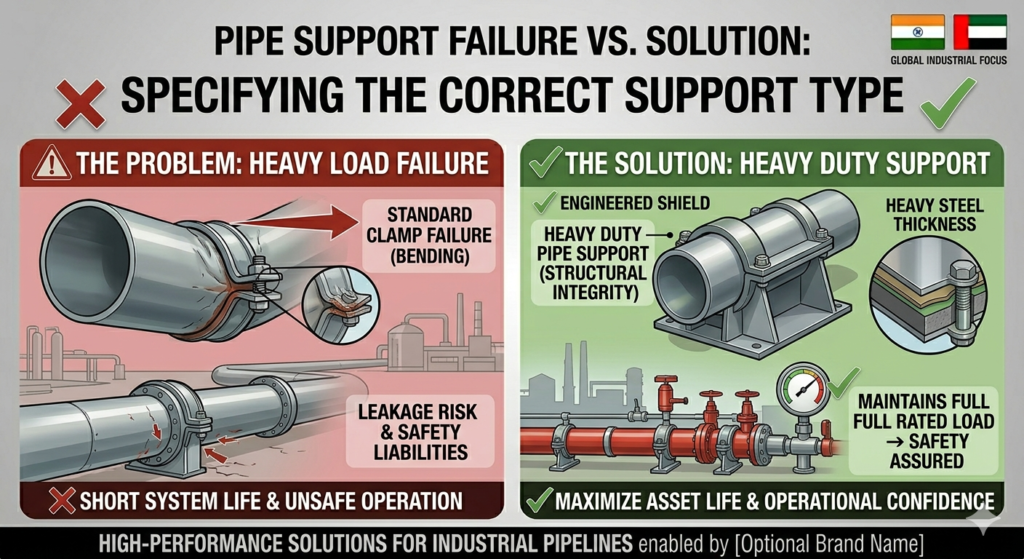
Industrial pipelines carry enormous weight — and when you use a regular or undersized clamp on a heavy pipe, the results can be dangerous. Over time, standard clamps bend, loosen, and fail under excessive load. This leads to pipe sagging, joint stress, leakage, and in serious cases, complete pipeline collapse. In industrial environments, this is not just a maintenance issue — it is a safety hazard.
Heavy duty pipe supports are engineered specifically to handle high-load pipelines without compromise.
Where Heavy Duty Pipe Supports Are Required
Heavy duty clamps and supports are essential in:
- Industrial manufacturing plants and process piping systems
- Large diameter water supply and distribution pipelines
- Fire fighting and fire suppression pipeline networks
- HVAC systems with large insulated pipes
- Chemical and petrochemical plant pipelines
- Power plant steam and condensate lines
- Building construction with overhead MEP (Mechanical, Electrical & Plumbing) services
If your pipeline carries high pressure, high temperature, or simply has a large diameter and heavy weight — standard clamps are not the right choice.
What Makes Heavy Duty Pipe Supports Different
Heavy duty pipe supports are built to a higher standard in every way:
- Material strength — Made from high-grade MS (mild steel), SS (stainless steel), or galvanized steel for maximum structural integrity
- Load bearing capacity — Designed to handle the combined weight of the pipe, fluid inside, and insulation
- Anti-vibration performance — Reduces pipe movement caused by fluid flow, pressure surges, or external vibration
- Corrosion resistance — Treated or coated for long service life in humid, outdoor, or chemically exposed environments
- Stability under thermal expansion — Allows controlled movement without damaging the support or the pipe
The Most Common & Costly Mistake
The biggest mistake made during pipeline installation is selecting a clamp based on what is available in stock — rather than what the pipeline actually needs. This shortcut leads to:
- Premature clamp failure
- Pipe bending and misalignment
- Increased maintenance costs
- Risk to workers and surrounding infrastructure
Always select pipe supports based on engineering requirements, not convenience.
Pipe Support Selection Checklist
Before finalizing any pipe clamp or support, verify the following:
- Pipe weight — Total load including fluid weight and insulation
- Pipe diameter — Correct size match is critical for grip and load distribution
- Support spacing / span — Distance between two support points determines the bending load on each clamp
- Anchor and structure strength — The surface to which the clamp is fixed must also be capable of bearing the load
- Operating environment — Indoor vs outdoor, temperature range, humidity, chemical exposure
- Pipe material — MS, GI, CPVC, or SS pipes may require different clamp designs
- Vibration and dynamic loads — High-flow or pump-connected lines need vibration-resistant supports
Why Proper Pipe Support Systems Matter
A well-designed pipe support system:
- Extends the life of your entire pipeline
- Prevents costly leaks and breakdowns
- Ensures compliance with safety and building codes
- Reduces long-term maintenance expenses
- Protects workers and surrounding equipment
In industrial and commercial projects, the pipe support system is as important as the pipe itself. Cutting corners here creates problems that are expensive to fix later.
Expert Advice
Every pipeline is different. The right support depends on your specific pipe size, load, spacing, and environment. Do not finalize your clamp selection without consulting a specialist.
Call us before finalizing your pipe support system — we help you choose the right product for your exact requirement, the first time.