
Here’s the fully expanded, SEO-friendly and educational version for your website:
Why Fasteners Fail Due to Corrosion – And How to Avoid It for Long-Term Structural Safety and Performance
Failure Dikhta Hai Suddenly… But Corrosion Slowly Hota Hai
This is the most dangerous characteristic of fastener corrosion — and the one that catches contractors, facility managers, and building owners completely off guard every single time. The failure appears sudden. The bolt snaps. The anchor pulls out. The screw strips from its substrate. The cladding panel loosens. The pipe support drops. It looks like an unexpected, unpredictable event.
But it is never sudden. It is never unexpected. And it is never unpredictable — if you know what to look for.
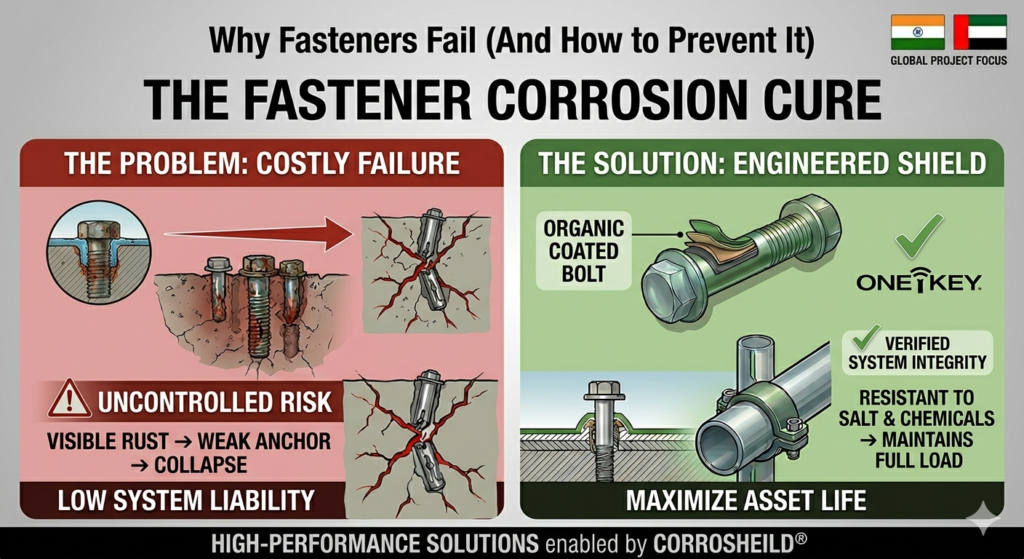
Every fastener failure caused by corrosion is the final visible result of a long, slow, invisible process that began at the molecular surface of the metal the moment it was exposed to its environment. Corrosion works from the outside in — and by the time any visible sign appears on the surface, the structural cross-section of the fastener has already been significantly compromised deep within the material.
Understanding how corrosion develops, how to recognize its early warning signs, and how to prevent it through correct material selection, protective coatings, and regular inspection is one of the most important bodies of knowledge for any construction professional, MEP contractor, facade engineer, or facility manager working on projects across Delhi, Assam, Dubai, and throughout India and the Middle East.
The Real Problem – Corrosion Starts From Inside and Weakens the Fastener Long Before Failure
Most people understand corrosion as a surface phenomenon — they see rust on the outside of a bolt or screw and assume that what they see represents the full extent of the damage. This assumption is fundamentally wrong and dangerously misleading.
Corrosion is an electrochemical process that initiates at the metal surface wherever the protective coating, oxide layer, or galvanized finish has been breached — at thread roots, cut edges, installation damage points, or microscopic surface defects. Once initiated, the corrosion process progresses inward through the metal cross-section, converting strong structural steel into weak, brittle iron oxide that has a fraction of the original material’s tensile and shear strength.
The critical danger is that this internal cross-section reduction is completely invisible from outside the fastener. A corroding bolt may look acceptable on casual visual inspection while having lost 40, 50, or even 60 percent of its original load-bearing cross-section internally. It continues to carry load — right up until the remaining uncorroded cross-section can no longer sustain the applied stress, at which point fracture occurs suddenly and completely without any preceding visible warning.
This is why corrosion-induced fastener failures always appear sudden to observers — because the visible failure event is simply the final moment in a long progressive weakening process that has been underway invisibly for months or years.
How Corrosion Develops in Fasteners – The Progressive Stages
Stage 1 – Coating Breach and Initiation Every fastener begins its service life with some form of corrosion protection — factory zinc plating, hot-dip galvanizing, mechanical galvanizing, stainless steel passive oxide layer, or specialized coating system. Corrosion initiation begins at any point where this protective system is breached — through installation damage at thread engagement points, cut or drilled edges on site, mechanical abrasion during handling, or microscopic manufacturing defects in the coating.
Stage 2 – Surface Oxidation and Rust Formation Once the base metal is exposed to moisture and oxygen, the electrochemical corrosion reaction begins. Iron atoms in the steel are oxidized to form iron oxide — commonly known as rust. At this stage, rust marks begin appearing on the fastener surface and on the substrate or connected material around the fastener head. This is the first visible sign of active corrosion and should be treated as an urgent warning signal, not a cosmetic issue.
Stage 3 – Progressive Cross-Section Reduction As corrosion continues unchecked, the effective load-bearing cross-section of the fastener reduces progressively. Thread roots — the most stress-critical geometry on any threaded fastener — are particularly vulnerable because their sharp internal angles create stress concentration points where corrosion penetrates rapidly. As thread root material is lost to corrosion, the fastener’s tensile strength and stripping resistance drop dramatically.
Stage 4 – Mechanical Loosening and Connection Instability Corrosion products — iron oxide and related compounds — have a significantly greater volume than the original steel they replace. This volumetric expansion generates internal stress in the connection, progressively loosening the clamping force that keeps the fastener tight. Corroding fasteners in bolted connections lose preload progressively, allowing joint movement, fretting, and accelerated further corrosion in the now-mobile connection interface.
Stage 5 – Sudden Structural Failure The remaining uncorroded cross-section reaches a point where it can no longer sustain the applied structural load. Fracture occurs suddenly — in tension, shear, or combined loading depending on the application. At this stage the consequences range from minor maintenance incidents to catastrophic structural failures depending on the criticality of the connection and the load being carried.
Early Warning Signs of Fastener Corrosion You Must Never Ignore
Recognizing corrosion warning signs during routine inspection allows intervention before progressive weakening reaches the failure threshold. Train your maintenance and inspection teams to identify and immediately report these critical indicators:
Rust Marks and Staining Any visible rust coloration on a fastener surface, or rust staining on the substrate, connected material, or surface finish around a fastener location is an active corrosion warning. In stainless steel fasteners, rust staining can indicate either incorrect grade specification for the environment or contamination of the passive surface layer — both requiring immediate investigation and likely fastener replacement.
Loose Fasteners A fastener that was correctly installed and torqued but has become loose during service without any evidence of mechanical disturbance has almost certainly lost clamping force due to corrosion-induced preload loss or thread degradation. Never simply re-torque a corroding fastener — assess the extent of corrosion damage and replace if any doubt exists about residual load capacity.
Surface Pitting and Damage Pitting corrosion — characterized by small but deep localized attack sites on the fastener surface — is particularly dangerous because it creates severe stress concentration points that dramatically reduce fatigue life and impact resistance. Pitted fasteners in dynamic or vibrating applications should be replaced immediately regardless of apparent residual section.
White Powder Deposits White or grey powdery deposits on aluminum fasteners or around zinc-plated steel fasteners in contact with aluminum indicate active galvanic corrosion — the accelerated attack that occurs when dissimilar metals in electrical contact exchange ions through a conductive electrolyte such as moisture. Galvanic corrosion can progress extremely rapidly and requires immediate material compatibility review and fastener replacement.
Crevice Staining and Deposit Buildup Dark staining, mineral deposits, or biological growth in crevices between fastener head and substrate surface, or under washers and nuts, indicates trapped moisture and active crevice corrosion — one of the most aggressive localized corrosion mechanisms in fastening applications.
Corrosion Prevention – The Complete Technical Guide to Protecting Your Fasteners
✔ Use Correctly Specified Coated Products
Coating selection must be matched to the corrosion category of the installation environment. The international ISO 9223 standard classifies atmospheric corrosion environments from C1 (very low — dry indoor) through C5 (very high — industrial and coastal) and CX (extreme — offshore marine). Specify fastener coatings rated for the actual corrosion category of your project:
— Electro-galvanized zinc coating — Suitable for C1 to C2 indoor and sheltered environments only. Minimum specification for any application with occasional moisture exposure.
— Hot-dip galvanized coating — Suitable for C2 to C3 outdoor urban and suburban environments. The minimum acceptable coating for most outdoor construction fastening applications in Indian cities including Delhi, Noida, and Gurgaon.
— Mechanical zinc plating — Suitable for C2 to C3 environments where hot-dip galvanizing dimensional distortion is not acceptable on precision fasteners.
— Dacromet and Geomet coating systems — High-performance zinc-aluminium flake coatings suitable for C3 to C4 environments including industrial and high-humidity outdoor applications. Excellent performance in pollution-heavy urban environments.
— Xylan and fluoropolymer coating systems — Premium coating systems providing exceptional corrosion resistance combined with low friction coefficient. Suitable for C4 to C5 environments and chemical exposure applications.
— Grade 304 stainless steel — Inherently corrosion resistant through passive oxide layer formation. Suitable for C3 to C4 environments including outdoor urban installations and moderate humidity exposure across Indian cities.
— Grade 316 stainless steel — Enhanced corrosion resistance through molybdenum addition. The minimum specification for C4 to C5 environments including coastal installations, high-humidity industrial areas, and all fastening applications in Dubai, Abu Dhabi, and coastal regions of India including Goa, Kerala, Mumbai, and Chennai.
— Duplex and super duplex stainless steel — For extreme CX corrosion category offshore and chemical process environments where even grade 316 provides insufficient protection.
✔ Use Correct Base Material for the Environment
Coating alone is not always sufficient protection in aggressive corrosion environments. In C4 and C5 category installations, specify fasteners manufactured from inherently corrosion-resistant base materials — stainless steel, titanium, or high-performance nickel alloys — rather than relying solely on surface coatings applied to carbon steel substrates.
Coatings can be damaged during installation, abraded during service, or simply reach the end of their protective life before the intended service life of the structure. When this happens on a carbon steel fastener with no inherent corrosion resistance, active corrosion initiates immediately. On a stainless steel fastener, the passive oxide layer reforms automatically — providing continued protection even after surface damage.
✔ Prevent Galvanic Corrosion Through Correct Material Pairing
Galvanic corrosion occurs when two dissimilar metals in electrical contact are exposed to a conductive electrolyte such as water or moisture. The less noble metal in the galvanic couple corrodes preferentially and rapidly — sometimes at rates many times faster than either metal would corrode alone.
Always verify galvanic compatibility between fastener material and the materials being connected. Use isolation washers, sleeves, and sealants to break the electrical connection between dissimilar metals in outdoor and humid environments. Never use carbon steel fasteners in direct contact with aluminum, copper, or stainless steel components in moisture-exposed applications without appropriate isolation measures.
✔ Implement Regular Inspection and Maintenance Programs
Prevention is always significantly cheaper than repair — but prevention requires active monitoring to catch early-stage corrosion before it progresses to the structural failure threshold. Implement a structured fastener inspection program covering all structural, facade, MEP, and infrastructure fastening systems in your building or project:
— Annual visual inspection of all accessible fastener locations for rust staining, surface damage, and loosening — Biannual close inspection of high-risk locations including rooftop installations, plant rooms, external facade fixings, and coastal-facing elevations — Immediate inspection and assessment following any extreme weather event, flooding, or chemical spillage near fastening systems — Torque verification on critical bolted connections at defined service intervals — Photographic documentation of all inspection findings to enable trend monitoring over successive inspection cycles — Defined replacement criteria and escalation protocols when corrosion indicators exceed acceptable thresholds
High Risk Environments Requiring Enhanced Corrosion Protection Specification
These project environments demand upgraded fastener material and coating specification beyond standard practice:
✔ Coastal and Marine Locations — Within 1 kilometer of the sea coastline, salt aerosol concentration in the atmosphere creates C4 to C5 category corrosion conditions. Grade 316 stainless steel is the minimum fastener specification for all applications in this zone. Projects in Mumbai, Chennai, Goa, Kochi, and all coastal UAE locations including Dubai, Abu Dhabi, and Sharjah fall into this category.
✔ Industrial and Chemical Processing Environments — Chemical fumes, acid rain, process gas emissions, and industrial pollution create aggressive corrosion conditions for all metallic fasteners. Specify coated stainless steel or high-alloy fasteners for all industrial facility applications.
✔ High Humidity and Tropical Environments — Assam, Kerala, coastal Karnataka, and similar high-rainfall tropical regions create persistent moisture exposure conditions that dramatically accelerate corrosion on unprotected and inadequately coated fasteners.
✔ Pollution-Heavy Urban Environments — Delhi NCR, Mumbai, and other major Indian metros with high atmospheric pollution indexes create mildly acidic atmospheric conditions that accelerate corrosion on standard galvanized fasteners faster than equivalent rural or suburban environments.
✔ Swimming Pools and Water Treatment Facilities — Chlorine compounds in pool and treatment plant atmospheres are extremely aggressive toward standard stainless steel grades. Specify grade 316L or duplex stainless steel fasteners for all pool and water treatment applications.
✔ Cold Storage and Refrigeration Facilities — Condensation cycles from temperature differential between refrigerated spaces and ambient conditions create persistent moisture exposure on all building fabric fasteners requiring enhanced corrosion protection specification.
The True Financial Cost of Fastener Corrosion – Why Prevention Always Wins
The financial argument for correct corrosion protection specification is overwhelming when the full lifecycle cost of corrosion failure is honestly accounted:
A structural fastener that costs a few rupees more per unit in a corrosion-resistant grade or coating can prevent a fastener replacement program that costs hundreds of times more per fixing point when the full cost of access equipment, labour, substrate repair, material replacement, and consequential damage is included.
Facade cladding fastener corrosion failures require complete re-fastening of affected panels — including scaffolding, panel removal, substrate assessment, new anchor installation, and panel reinstatement — at a cost that typically represents 20 to 50 times the original fastening material cost per square meter of facade.
MEP pipe support fastener corrosion failures in concealed ceiling voids require ceiling demolition for access, pipe support replacement, pipe realignment, and full ceiling reinstatement — at a cost that dwarfs the original specification upgrade that would have prevented the failure entirely.
Prevention is not just cheaper than repair — in most real-world fastener corrosion failure cases, prevention costs less than 5 percent of the total remediation cost that follows an avoidable failure.
Final Advice for Engineers, Contractors, Facility Managers, and Building Owners
Corrosion never stops. It works continuously, invisibly, and relentlessly on every unprotected or inadequately protected fastener in your building or structure from the moment of installation. The only effective response is correct specification from the beginning — the right material, the right coating, the right installation practice, and the right inspection program to catch any developing issues before they reach the failure threshold.
Do not make fastener material and coating decisions based on unit price alone. Make them based on the full lifecycle cost of the connection — including the cost of the failure you are preventing. And always consult with a technically competent fastening specialist before finalizing your fastener specification for any project where corrosion is a real environmental factor.
Prevention is always cheaper than repair. Always.
📞 Call us before finalizing your fasteners — get free expert technical guidance on corrosion-resistant fastener selection for your specific environment, application, and project location 📲 WhatsApp us the word “ANCHOR” to receive corrosion protection recommendations, fastener material specifications, and complete fastening solutions tailored to your project requirements 🎯 Get free fastener corrosion assessment and selection support from our technical team — helping contractors, engineers, and facility managers across India and the Middle East specify correctly and avoid costly corrosion failures
Supplying certified corrosion-resistant fasteners, stainless steel anchors, coated self-drilling screws, chemical anchors, mechanical anchors, and complete fastening hardware across Delhi, Noida, Gurgaon, Faridabad, Ghaziabad, Mumbai, Bangalore, Chennai, Hyderabad, Pune, Assam, Guwahati, Gujarat, Dubai, Abu Dhabi, Sharjah, UAE, and all major cities across India and the Middle East.