

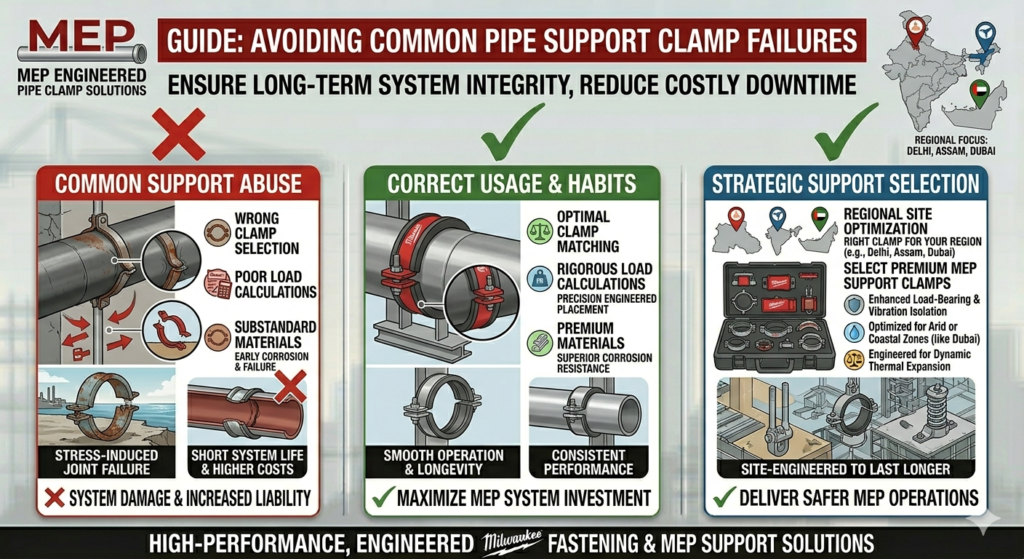
Here’s the fully expanded, SEO-friendly and educational version for your website:
Rubber Lined Pipe Clamps – Why Vibration and Noise in Your Pipeline System Is a Clamp Problem, Not a Pipe Problem
Pipe Se Noise Aa Raha Hai? Problem Clamp Mein Ho Sakta Hai
If you are experiencing unusual vibration, persistent noise, or unexplained movement in your building’s pipeline system, the first place most engineers and contractors look is the pipe itself — the material, the joints, the fittings, the pump connections. But in the majority of real-world MEP cases, the actual root cause is far simpler and far less expensive to fix: the wrong type of pipe clamp was used during installation.
A standard rigid metal clamp where a rubber lined clamp was required is one of the most common and most overlooked mistakes in HVAC, plumbing, and mechanical pipeline installations across commercial buildings, residential towers, industrial facilities, and infrastructure projects in Delhi, Assam, Dubai, and beyond.
This guide explains exactly what rubber lined pipe clamps are, why they matter, where they must be used, and how selecting the right clamp can transform the acoustic and mechanical performance of your entire pipeline system.
The Real Problem – Vibration, Noise, and Pipeline Movement in Buildings
Vibration and noise in building pipeline systems are among the most persistent and frustrating complaints received by facility managers, building owners, and MEP contractors after project handover. Tenants complain. Hotel guests complain. Hospital patients are disturbed. Office workers lose productivity. And the contractor receives call after call demanding a solution to a problem that should have been prevented at the design and procurement stage.
The symptoms are consistent across every project type:
— Continuous low-frequency vibration hum traveling through walls and slabs — Clicking, knocking, or rattling sounds from pipe runs during pump operation — Visible pipe movement during system startup and shutdown cycles — Progressive loosening of pipe joints and connections due to vibration fatigue — Structural surface cracking around pipe penetrations and support fixing points — Increasing noise levels over time as clamp connections degrade
The main reason behind all of these symptoms in the vast majority of cases is one critical specification error: a standard rigid metal clamp was used in an application that required a rubber lined vibration isolating pipe clamp.
What Is a Rubber Lined Pipe Clamp?
A rubber lined pipe clamp is a precision-engineered pipe support component that incorporates a continuous layer of high-grade elastomeric rubber bonded to the inner surface of the clamp body that contacts the pipe. This rubber lining acts as a mechanical and acoustic isolation barrier between the pipe and the rigid metal clamp body and building structure.
Unlike a standard metal-to-metal pipe clamp that creates a direct rigid connection between the pipe and the structure, a rubber lined clamp creates a flexible, energy-absorbing interface that interrupts the transmission path of vibration and structure-borne noise between the pipeline system and the building fabric.
The rubber lining is available in different elastomer compounds depending on the application requirements including natural rubber for standard HVAC and plumbing applications, neoprene rubber for moderate chemical and oil resistance, EPDM rubber for hot water and outdoor UV-exposed applications, and silicone rubber for high-temperature pipeline systems.
The outer clamp body is typically manufactured from carbon steel with hot-dip galvanizing, stainless steel grade 304 or 316, or electro-galvanized finish depending on the environmental corrosion category of the installation.
Why Rubber Lined Pipe Clamps Are Critical for MEP System Performance
The rubber lining inside a pipe clamp performs multiple simultaneous functions that are impossible to achieve with a standard rigid metal clamp:
✔ Vibration Reduction and Isolation — The elastomeric rubber absorbs and dissipates mechanical vibration energy generated by pumps, compressors, fans, chillers, and fluid flow turbulence before it can transmit into the building structure. This is the single most important function in any mechanically active pipeline system
✔ Noise Reduction and Acoustic Isolation — By breaking the rigid structural connection between the pipe and the building, rubber lined clamps prevent structure-borne sound transmission that causes noise complaints in occupied spaces above, below, and adjacent to plant rooms and pipe runs
✔ Pipe Surface Protection — The rubber lining eliminates direct metal-to-metal contact between the pipe outer surface and the clamp body, preventing surface abrasion, galvanic corrosion between dissimilar metals, and coating damage on coated or insulated pipelines
✔ Extended System Life — By eliminating vibration fatigue at pipe support points, rubber lined clamps significantly extend the service life of pipe joints, welds, threaded connections, and the pipes themselves — reducing maintenance frequency and lifecycle replacement costs
✔ Thermal Movement Accommodation — The rubber lining provides a degree of controlled flexibility that accommodates minor thermal expansion and contraction movements in the pipeline without creating stress concentrations at support points
✔ Prevention of Galvanic Corrosion — In systems where copper, stainless steel, or other dissimilar metal pipes are supported on carbon steel structures, the rubber lining provides electrical isolation that prevents galvanic corrosion cell formation between pipe and support
Where Rubber Lined Pipe Clamps Must Be Used — Critical Applications
Rubber lined pipe clamps are not optional accessories in the following applications. They are technically necessary components for correct system performance:
✔ HVAC Chilled Water Pipelines — All supply and return chilled water pipelines connected to chillers, cooling towers, and air handling units require rubber lined supports to isolate compressor and pump vibration from the building structure
✔ Hot Water and Heating System Pipelines — Boiler-connected hot water pipelines with significant temperature variation require rubber lined supports with EPDM or silicone rubber rated for elevated operating temperatures
✔ Pump Discharge and Suction Pipelines — The first several support points downstream and upstream of any pump installation are critical vibration transmission points requiring rubber lined isolation clamps
✔ Compressed Air Pipeline Systems — Compressor-generated pulsation and vibration in compressed air distribution systems transmits aggressively into building structures without proper rubber isolated pipe supports
✔ Fire Sprinkler and Fire Fighting Systems — Rubber lined clamps in fire pipeline systems prevent water hammer vibration from transmitting into the structure during system activation and pressure testing
✔ Plumbing Cold and Hot Water Risers — Vertical riser pipes in multi-storey residential and commercial buildings require rubber lined riser clamps to prevent water flow noise from transmitting between floors
✔ High Vibration Industrial Areas — Any pipeline running through or adjacent to manufacturing equipment, generators, compressor rooms, or mechanical plant areas requires rubber lined supports throughout the affected zone
✔ Commercial Buildings and Hotels — Acoustic performance standards in hotels, hospitals, offices, and residential buildings make rubber lined pipe clamps mandatory in all concealed and accessible pipe runs
✔ Rooftop and Plantroom Installations — External plant rooms and rooftop mechanical installations where thermal cycling and equipment vibration combine require rubber lined corrosion-resistant clamps throughout
The Most Common and Costly Mistake – Using a Standard Metal Clamp Where a Rubber Lined Clamp Is Required
This mistake is made on MEP project sites every single day. The reason is almost always the same: rubber lined clamps cost slightly more per unit than standard metal clamps, and under budget pressure, the cheaper option is selected without understanding the technical consequences.
The result of this decision consistently produces:
👉 Noise Complaints — Building occupants, hotel guests, hospital patients, and office workers experience persistent vibration noise that travels through slabs, walls, and ceilings from inadequately isolated pipeline systems
👉 Progressive Pipe and Joint Damage — Without vibration isolation, repeated mechanical cycling at rigid support points causes metal fatigue cracking at pipe joints, threaded connections, and welded sections — leading to leaks that damage building interiors
👉 Structural Surface Damage — Vibration transmitted through rigid clamps into concrete and masonry causes progressive micro-cracking around fixing points that worsens over time
👉 Expensive Remedial Work — Retrofitting rubber lined clamps into a completed and finished building requires cutting open ceilings and walls, removing existing rigid clamps, installing replacement rubber lined clamps, and reinstating all finished surfaces — at a cost many times greater than the original specification upgrade would have required
👉 Contractual and Legal Liability — Persistent noise and vibration complaints in completed buildings lead to contractual disputes, defect liability claims, and in serious cases legal action against MEP contractors and consultants
The cost difference between specifying rubber lined clamps from the start versus retrofitting them after completion is typically 10 to 20 times greater. The correct specification decision at procurement stage is always the most cost-effective outcome.
Technical Selection Guide – How to Choose the Right Rubber Lined Pipe Clamp
Follow this selection checklist before specifying rubber lined pipe clamps for any MEP application:
✔ Match Clamp Size Precisely to Pipe Outside Diameter Always verify the actual outside diameter of your pipe including any insulation or cladding layer. Rubber lined clamps must grip the pipe surface uniformly around the full circumference — an oversized clamp bore defeats the purpose of the rubber lining by allowing pipe movement within the clamp
✔ Verify Rubber Compound for Operating Temperature Natural rubber is suitable for ambient temperature applications up to approximately 70°C. EPDM rubber is required for hot water systems operating above 70°C. Silicone rubber is specified for high-temperature steam and process pipelines. Never use a standard rubber lined clamp on a pipeline operating above its rubber compound’s rated temperature limit
✔ Check Rated Load Capacity Rubber lined clamps must carry the same total supported load as standard clamps — pipe weight, fluid weight, insulation weight, and dynamic loads. Verify that the selected clamp’s rated load capacity provides adequate safety factor for your calculated support load
✔ Assess Environmental Corrosion Category Select clamp body material and finish based on installation environment. Electro-galvanized finish for dry indoor applications, hot-dip galvanized for humid and outdoor conditions, grade 304 stainless steel for general corrosive environments, and grade 316 stainless steel for coastal, marine, and chemically aggressive locations including Dubai and coastal Assam projects
✔ Verify Rubber Lining Quality and Thickness Rubber lining quality varies significantly between suppliers. Specify minimum rubber lining thickness appropriate for your vibration isolation requirement. Request rubber hardness (Shore A) rating from your supplier — typically 40 to 60 Shore A for standard HVAC vibration isolation applications
✔ Confirm Acoustic Performance Requirement For projects with strict acoustic performance specifications — hotels, hospitals, recording studios, residential buildings — specify rubber lined clamps with documented insertion loss values from acoustic testing rather than relying on generic product claims
Delhi, Assam and Dubai – Location Specific Rubber Lined Clamp Recommendations
Delhi NCR Projects: High summer temperatures require rubber compounds rated for elevated ambient conditions in rooftop and non-air-conditioned plant room applications. Pollution and moisture from monsoon seasons demand hot-dip galvanized or epoxy-coated clamp bodies for semi-exposed installations. Specify EPDM rubber lining for all hot water and heating system applications across Delhi projects.
Assam and Northeast India Projects: Extreme humidity and high annual rainfall create aggressive corrosion conditions for all metallic components. Specify hot-dip galvanized or stainless steel clamp bodies as a minimum for all Assam MEP installations. EPDM rubber lining is recommended for all applications due to its superior moisture and weather resistance compared to natural rubber compounds.
Dubai and UAE Projects: Salt air corrosion demands grade 316 stainless steel clamp bodies for all outdoor, rooftop, and plant room installations across Dubai and the wider UAE. High ambient temperatures in plant rooms and rooftop installations require EPDM or silicone rubber lining compounds rated for elevated temperature service. Acoustic performance standards in Dubai’s premium hospitality and residential developments make rubber lined clamps mandatory across all concealed pipe runs.
Small Change in Clamp – Big Improvement in System Performance
The upgrade from a standard rigid metal pipe clamp to a correctly specified rubber lined pipe clamp represents one of the smallest cost increases and one of the largest performance improvements available in any MEP system specification. The per-unit price difference is modest. The difference in acoustic performance, vibration isolation, pipe surface protection, and long-term system reliability is transformational.
One correct specification decision at the procurement stage eliminates noise complaints, prevents pipe damage, extends system life, and protects the professional reputation of every contractor and consultant associated with the project.
Final Advice for MEP Engineers, HVAC Contractors, and Plumbing Consultants
Never specify a standard rigid metal clamp in an application where vibration, noise, or pipe surface protection is a requirement. The technical case for rubber lined pipe clamps in active mechanical pipeline systems is clear, proven, and universally supported by MEP engineering best practice.
Consult with a technically competent pipe support clamp supplier before finalizing your specification. Get the right rubber compound, the right clamp body material, the right size, and the right load rating for your specific application and project location. And make that decision before installation — not after the noise complaints start arriving.
📞 Call us before finalizing your pipe clamps — get free expert technical guidance on rubber lined clamp selection for your specific pipeline system, application, and project location 📲 WhatsApp us the word “CLAMP” to receive rubber lined pipe clamp recommendations, technical datasheets, and complete MEP fastening solutions tailored to your project requirements 🎯 Get free pipe support selection support from our technical team — helping MEP contractors, HVAC engineers, and plumbing consultants across India and the Middle East specify correctly from day one
Supplying certified rubber lined pipe clamps, standard pipe supports, acoustic isolation clamps, anchors, and complete MEP fastening hardware across Delhi, Noida, Gurgaon, Faridabad, Ghaziabad, Mumbai, Bangalore, Chennai, Hyderabad, Pune, Assam, Guwahati, Gujarat, Dubai, Abu Dhabi, Sharjah, UAE, and all major cities across India and the Middle East.