

Tool Galat Hai… Toh Anchor Bhi Fail Hoga
In construction fastening and anchor installation, there is a chain of quality that runs from the drilling tool all the way through to the finished structural connection. Every link in that chain matters. But the very first link — the drilling tool — determines the quality of everything that follows. A poor quality, worn out, or incorrectly selected drilling machine produces poor quality holes. And poor quality holes produce weak, unreliable, and potentially dangerous anchor connections — regardless of how premium the anchor product itself is.
This is a reality that experienced structural engineers, facade contractors, MEP installers, and construction professionals across Delhi, Mumbai, Dubai, and throughout India and the Middle East understand from hard-won site experience. Yet on project sites every day, anchor installations are being compromised at the very first step because the wrong drilling tool — or a worn out, low-quality machine — was used to prepare the hole.
This guide explains exactly why your drilling tool choice is inseparable from your fastening quality, what goes wrong when the wrong tool is used, and how investing in professional-grade drilling equipment like Milwaukee delivers measurable, documented improvements in anchor performance, installation speed, and long-term project reliability.
The Real Problem – Low Quality Tools Create Fundamentally Compromised Holes
The physics of anchor performance are straightforward and unforgiving. Every anchor system — whether mechanical expansion anchor, chemical adhesive anchor, undercut anchor, or screw anchor — is engineered to perform at its rated load capacity when installed in a hole that meets precise dimensional and surface quality specifications.
These specifications include exact hole diameter within tight tolerances, minimum and maximum embedment depth, perpendicular hole alignment within specified angular tolerance, and a clean hole wall surface free of dust, loose aggregate, and debris.
A low-quality or worn-out drilling machine is physically incapable of consistently meeting these specifications. The consequences appear directly in anchor performance:
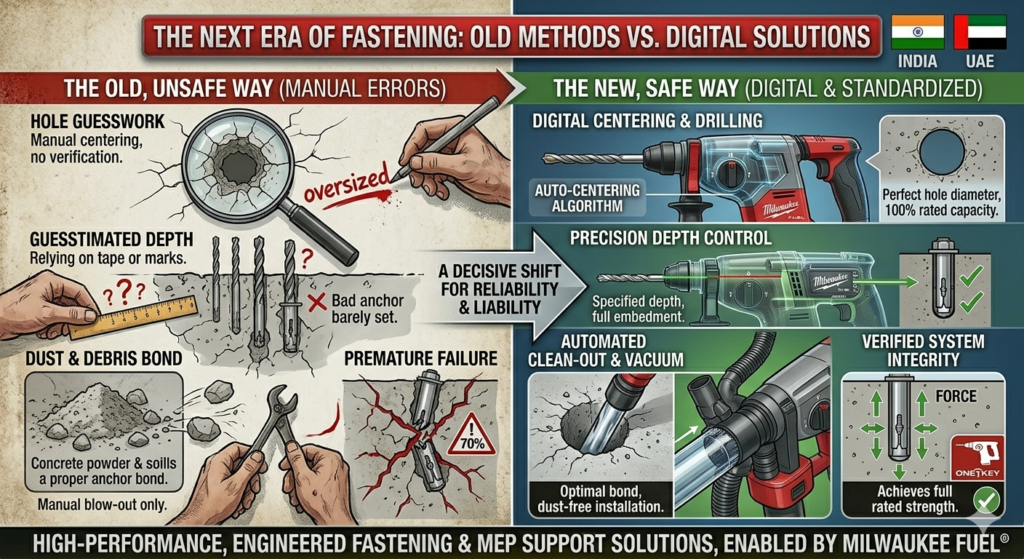
Wrong Hole Size — A cheap or worn drill machine with inadequate chuck precision and spindle rigidity produces holes that run oversized relative to the drill bit nominal diameter. Lateral vibration and spindle runout in low-quality machines cause the bit to cut a hole larger than its stated size — destroying the tight dimensional fit that mechanical anchors require to develop full expansion load capacity.
Improper Depth — Inconsistent motor torque and speed in low-quality machines causes the operator to lose feel and control during drilling, resulting in holes of variable and unpredictable depth across an installation. Without consistent depth, anchor embedment varies from point to point — creating a fastening layout with wildly inconsistent load capacity at individual anchor locations.
Poor Hole Finish — Professional anchor installation in concrete requires clean, sharp hole walls produced by proper carbide tip impact and rotation. Low-quality machines with inadequate impact energy and inconsistent RPM produce rough, torn hole walls with loose aggregate and dust embedded in the surface — compromising both mechanical anchor expansion contact and chemical anchor resin bonding across the full hole depth.
Why Your Drilling Tool Is the Foundation of Your Entire Fastening System
Strong and reliable fastening depends on three non-negotiable drilling parameters that only a professional quality drilling machine can consistently deliver:
✔ Accurate Hole Diameter — Professional rotary hammer drills maintain precise spindle concentricity and chuck accuracy throughout the drilling operation, ensuring hole diameter stays within the tight tolerance band required by anchor manufacturers for full rated performance. Consistent diameter across every hole in an installation means consistent load capacity at every anchor point — which is the engineering basis on which the entire fastening layout is designed.
✔ Correct and Consistent Depth — Professional drilling machines with calibrated depth stop systems and consistent power delivery ensure every hole reaches exactly the specified embedment depth — not approximately, not sometimes, but on every single hole throughout the installation. Consistent embedment depth is directly proportional to anchor tensile load capacity in every anchor system type.
✔ Clean, Sharp Hole Geometry — Professional SDS rotary hammer drills with optimized impact energy and rotation speed produce clean, sharp hole walls with well-defined geometry that maximizes the mechanical interlock surface for expansion anchors and the bonding surface area for chemical anchors. Clean hole geometry produced by a professional machine is the single biggest factor in achieving published anchor load ratings on real substrates.
Professional Drilling Tools – Why Milwaukee Sets the Standard for Anchor Installation
When it comes to professional drilling equipment for construction fastening and anchor installation applications, Milwaukee stands as one of the most trusted and specified brands among structural engineers, specialist fastening contractors, and construction professionals worldwide — and for very good technical reasons.
Milwaukee professional rotary hammer drills deliver performance characteristics that directly translate into superior anchor installation quality on every project:
✔ POWERSTATE Brushless Motor Technology — Milwaukee’s brushless motor systems deliver consistent, regulated power output throughout the drilling operation — maintaining constant RPM and impact energy from the first hole to the last, regardless of varying concrete hardness or operator technique. Consistent power means consistent hole quality across every anchor point in the installation.
✔ REDLINK PLUS Intelligence System — Advanced electronic overload protection and tool management prevents motor damage from overloading in hard aggregate concrete or when bits bind — protecting the tool investment and maintaining consistent performance throughout demanding installation schedules.
✔ FIXTEC and SDS-Plus Chuck Systems — Milwaukee’s precision-engineered chuck systems maintain tight dimensional tolerances between the drill bit shank and the chuck body, minimizing spindle runout and ensuring the drill bit cuts true to its nominal diameter throughout its service life.
✔ Optimized Impact Energy and BPM — Milwaukee rotary hammers are engineered with optimized impact energy ratings and blows-per-minute settings for efficient concrete penetration with clean hole wall geometry — producing the surface finish quality that anchor manufacturers specify as the condition for their published load ratings.
✔ Ergonomic Design for Sustained Accuracy — Milwaukee’s professional rotary hammer range is designed for sustained, accurate operation throughout full working days on construction sites. Balanced weight distribution, vibration-dampening handle systems, and intuitive controls allow operators to maintain precise drilling angle and pressure consistently — directly improving hole geometry quality across extended installation runs.
✔ REDLITHIUM Battery Technology for Cordless Models — Milwaukee’s cordless SDS rotary hammer drills powered by REDLITHIUM battery packs deliver consistent power output from full charge to end of charge — eliminating the power fade that causes hole quality deterioration in lesser cordless systems as battery charge depletes during the working day.
✔ Exceptional Durability for Site Conditions — Milwaukee tools are engineered and tested for the real conditions of construction sites — dust, debris, moisture, drops, and continuous heavy use. Professional-grade durability means consistent performance and hole quality throughout the tool’s working life rather than degradation that begins within months of purchase.
The Most Common and Costly Drilling Tool Mistake on Construction Sites
❌ Using Worn-Out or Cheap Drill Machines for Anchor Installation
This is the single most damaging tool decision made on construction sites in the context of anchor fastening quality. It happens for two reasons: cost pressure drives procurement toward the cheapest available drilling equipment, and worn professional tools are kept in service long past the point where their performance has degraded beyond acceptable tolerance.
The consequences of this decision are consistent and predictable:
Oversized holes reduce mechanical anchor expansion load capacity by 30 to 70 percent compared to correctly sized holes. Variable hole depth creates inconsistent embedment and unpredictable load capacity variation across the anchor layout. Poor hole wall finish reduces chemical anchor bond strength and creates void points in the cured resin. Off-angle holes introduce bending stress into anchor shafts under axial load. The cumulative effect is a fastening installation that looks correct from the outside but is fundamentally compromised in structural performance — invisible until the moment of failure.
The financial and safety consequences of anchor failure caused by poor drilling tool quality are always vastly greater than the cost difference between a professional-grade drilling machine and the cheap alternative that caused the problem.
Professional Drilling Equipment Selection Guide for Anchor Installation
For Anchor Diameters Up to M16 in Standard Concrete: Specify SDS-Plus rotary hammer drills with minimum 2J impact energy rating. Milwaukee M18 FUEL SDS-Plus rotary hammers in this category deliver professional-grade hole quality for the majority of anchor installation applications in construction and facade projects.
For Anchor Diameters M16 and Above in Hard or Reinforced Concrete: Specify SDS-Max rotary hammer drills with minimum 5J to 8J impact energy rating for large diameter anchor holes. Milwaukee M18 FUEL and corded SDS-Max rotary hammers provide the impact energy and hole quality required for heavy-duty structural anchor installations.
For Large Diameter Chemical Anchor Holes Near Reinforcement: Specify diamond core drilling systems for clean, dimensionally precise holes with smooth wall finish — particularly important for large diameter chemical anchor applications where hole wall quality directly determines bond strength across the full embedment depth.
For Cordless Anchor Installation on Sites Without Power Access: Milwaukee M18 FUEL cordless SDS rotary hammer systems with REDLITHIUM battery packs deliver corded-tool performance in a cordless platform — maintaining consistent hole quality throughout the full working day without power fade.
Tool Maintenance Protocol – Keeping Your Drilling Equipment at Peak Performance
Professional drilling tools only maintain their performance advantage when they are properly maintained. Implement this maintenance protocol on every site:
✔ Inspect SDS chuck mechanism daily for wear, debris accumulation, and proper bit retention before beginning drilling operations ✔ Clean dust and concrete debris from air vents after every working day to prevent motor overheating and premature wear ✔ Inspect and replace carbon brushes on brushed motor tools at manufacturer-specified intervals before brush wear causes motor damage ✔ Check depth stop collar calibration at the start of each installation session and verify against a reference gauge ✔ Inspect drill bits before every use and replace any bit showing carbide tip wear, body damage, or shank deformation ✔ Store rotary hammer drills in protective cases away from moisture, dust, and impact damage when not in use ✔ Schedule professional servicing at manufacturer-recommended intervals for all drilling tools used in heavy anchor installation work
The Direct Return on Investment of Professional Drilling Equipment
The business case for investing in professional-grade drilling tools for anchor installation is clear and quantifiable across every project type:
Fewer Failed Anchors — Consistent hole quality from professional tools means fewer anchor installations that fall below specification — reducing remedial work, material waste, and schedule delays caused by anchor failure during or after installation.
Faster Installation Rate — Professional rotary hammer drills with optimized impact energy drill anchor holes significantly faster than low-quality machines in hard concrete — directly increasing installation productivity and reducing labour cost per anchor point.
Lower Drill Bit Consumption — Professional machines that maintain consistent RPM and impact energy under load extend drill bit service life dramatically compared to cheap machines that overheat bits and cause rapid carbide tip degradation.
Reduced Tool Replacement Frequency — Professional-grade tools engineered for heavy site use last significantly longer than budget alternatives — reducing total tool ownership cost over the project lifecycle.
Engineering Confidence — Anchor installations completed with professional drilling equipment and verified hole quality give structural engineers, facade consultants, and project managers confidence that the fastening system will perform as designed — reducing inspection requirements, sign-off delays, and liability exposure.
Final Advice for Contractors, Site Engineers, and Fastening Specialists
Good fastening starts with good drilling. And good drilling starts with the right tool — a professional-grade rotary hammer drill that consistently delivers accurate diameter, correct depth, and clean hole geometry on every anchor installation throughout the entire project.
Do not compromise the quality of your anchor installations at the very first step by using worn-out or low-quality drilling equipment. The anchor manufacturer’s published load ratings, the structural engineer’s design calculations, and the safety of everyone who depends on those connections all assume that the hole was drilled correctly with a professional tool.
Invest in professional drilling equipment. Maintain it properly. Use it correctly. And give every anchor on your site the hole quality it needs to perform at its full rated strength.
📞 Call us before finalizing your drilling tools and anchor systems — get free expert technical guidance on professional drilling equipment selection for your specific anchor type, substrate, and project application 📲 WhatsApp us the word “ANCHOR” to receive professional drilling tool recommendations, anchor selection guidance, and complete fastening solutions tailored to your project requirements 🎯 Get free drilling tool and fastener selection support from our technical team — helping contractors, site engineers, and construction professionals across India and the Middle East achieve correct anchor installation quality from the very first hole
Supplying professional Milwaukee drilling tools, SDS drill bits, rotary hammer drills, mechanical anchors, chemical anchors, and complete fastening hardware across Delhi, Noida, Gurgaon, Faridabad, Ghaziabad, Mumbai, Bangalore, Chennai, Hyderabad, Pune, Assam, Guwahati, Gujarat, Dubai, Abu Dhabi, Sharjah, UAE, and all major cities across India and the Middle East.