
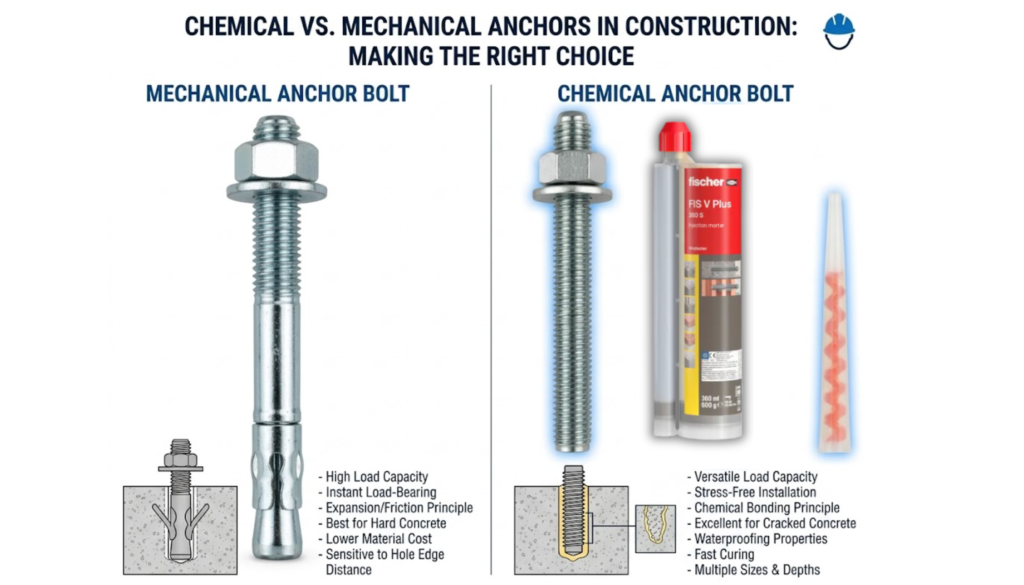
Use a mechanical anchor when you need speed, the concrete is solid and the anchor is away from edges. Use a chemical anchor for heavy or safety-critical loads, close edge or spacing distances, masonry, and rebar. That is the short answer. The details below help site engineers and buyers decide on a specific job.
How each one holds
Mechanical anchors (wedge, sleeve, drop-in, bullet) expand inside the hole and grip by friction. They can be loaded straight away.
Chemical anchors bond a rod or rebar to the concrete with resin along the full hole depth. There is no expansion force, so they are kinder to the base material, but they need curing time.


Choose a mechanical anchor when
- The base is solid, good-quality concrete
- Loads are light to medium
- You need to load the fixing immediately
- Anchors are well away from edges and from each other
Choose a chemical anchor when
- Loads are heavy, structural or safety-critical
- Anchors are close to an edge or close together
- You are fixing into brick, block or stone
- You are adding rebar to existing concrete
- Holes may be damp, or the fixing faces vibration
Cost and time
Mechanical anchors are cheaper per point and faster to install. Chemical anchors cost more and need curing time, but often allow fewer, smaller anchors for the same load and avoid cracked concrete near edges.
Common mistakes
- Using expansion anchors in hollow block, which only crack the wall
- Loading chemical anchors before they have cured
- Choosing on price alone for safety-critical fixings
Read more: why chemical anchors are used so widely in construction, how to use chemical anchors step by step, and when to use high-performance Hilti anchors.
Need help choosing?
Fasteners King has supplied anchors and fixings since 1979. We are India’s No. 1 Fischer channel partner (5 years in a row) and an Authorised Hilti Channel Partner, with stock in Delhi, Guwahati and Dubai. We stock both mechanical and chemical anchors from Hilti, Fischer and our own FastenKing range. See our chemical anchors in Delhi NCR or WhatsApp your application.
Also from Fasteners King: Anchor fasteners supplier in Delhi.